
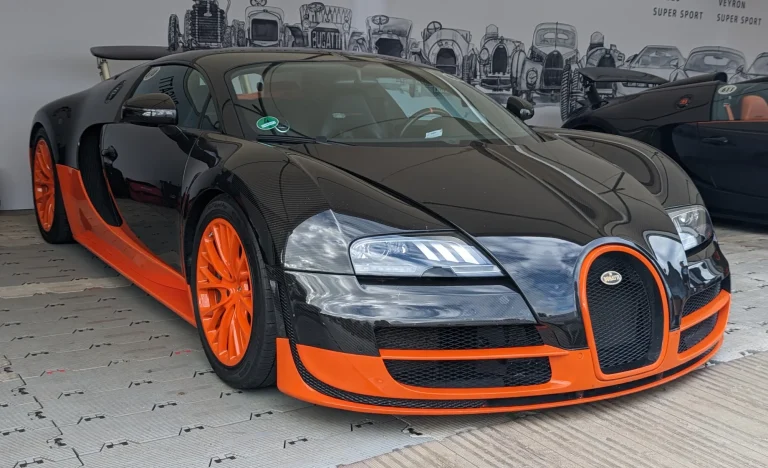
Concorde of the Road
When Volkswagen Group acquired the Bugatti name, chairman Ferdinand Piëch issued a decree that seemed impossible: build a car with 1,000 metric horsepower, a top speed of over 400 km/h (250 mph), and the ability to comfortably transport passengers to the opera that same evening. After years of delayed development, immense engineering hurdles, and rumored losses on every unit sold, the Bugatti Veyron 16.4 debuted in 2005. It didn’t just move the goalposts for hypercars; it demolished the stadium.
The Veyron’s bulbous, imposing shape was dictated entirely by aerodynamics and thermal management. To keep the massive engine from melting the car, the Veyron was equipped with an astonishing ten radiators. The active rear wing acted as an airbrake at high speeds, generating more drag than an ordinary hatchback.
- Hypercar
- Coupe
- Mid-Engine
The Heart of a Monster
The engineering marvel at the core of the Veyron is its 8.0-liter W16 engine. Essentially two narrow-angle V8 engines joined at the crank, it features four turbochargers and 64 valves. The transmission had to be specially developed by Ricardo—a 7-speed dual-clutch unit robust enough to handle the earth-shattering 1,250 Nm of torque without disintegrating.
- Top Speed Key: Unlocking the 253 mph limit requires inserting a special second key into the floor
- Tires: Custom Michelin Pilot Sport PAX tires glued to the wheels, costing roughly $40,000 to replace
- Brakes: Carbon-ceramic discs capable of stopping the car from 250 mph in under 10 seconds
Fun Fact: At its top speed of 253 mph, the Bugatti Veyron consumes 47,000 liters of air per minuteu2014as much air as a human breathes in four days.
Unfathomable Velocity
Driving the Veyron is surprisingly undemanding at low speeds. The cabin is trimmed in turned aluminum and flawless leather, with excellent visibility and a ride quality that rivals luxury sedans. It lulls you into a false sense of security.
When you push the accelerator to the floor, however, the experience is terrifyingly violent. The turbos spool with a massive inhalation of air just behind your head, and the all-wheel-drive system hooks up, launching the near two-ton car forward with the force of a fighter jet catapult. It reshapes your understanding of speed, making supercars of its era feel pedestrian in comparison.
“It is a triumph for lunacy. The Veyron is the greatest car ever made and the greatest car we will ever see in our lifetime.”
+ Pros
- Historical significance as the first 250+ mph production car
- Docile and easy to drive in traffic
- Exceptional build quality and materials
– Cons
- Maintenance costs are astronomically high
- Lacks the pure dynamic agility of lighter hypercars
- Design is more imposing than beautiful
The Benchmark
The Bugatti Veyron was a statement of absolute industrial might. It proved that engineering could overcome almost any physics barrier, cementing its status as the most significant hypercar of the 21st century’s first decade.
A Monument to Engineering
The Bugatti Veyron is a historic milestone that blended ultimate, record-breaking performance with unexpected daily usability and luxury.