
Origins
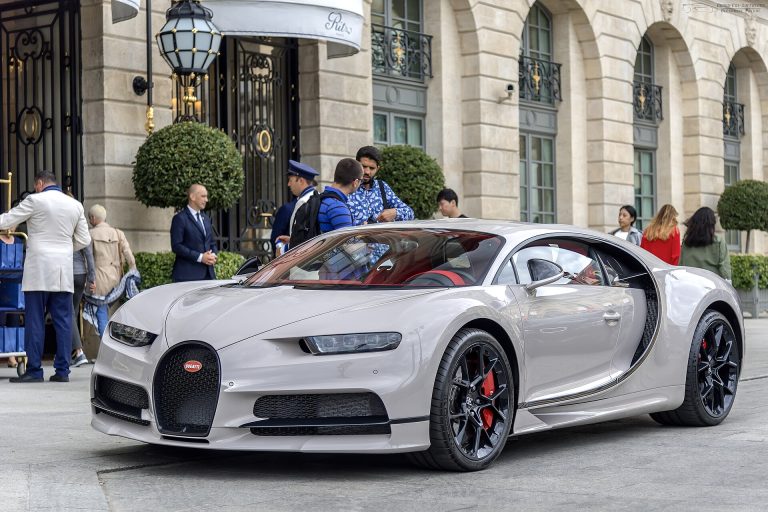
When Bugatti retired the Veyron in 2015, the brand needed an encore that could top a car many considered unbeatable. The result, unveiled at the 2016 Geneva Motor Show, was the Chiron — named after Louis Chiron, the Monegasque racing driver who won the 1931 Monaco Grand Prix in a factory Bugatti Type 51.
Where the Veyron had proven that a four-figure horsepower count could be made drivable, the Chiron set out to prove it could also be refined. Bugatti’s engineers redesigned the carbon-fiber monocoque, reworked the aerodynamics from scratch, and pushed the venerable W16 engine to outputs the Veyron’s architecture was never built to handle.
Development took roughly four years and drew on lessons from more than 1,850 individual changes made to the Veyron’s underlying concept, even though almost nothing physical carried over between the two cars. Bugatti also had a new breed of rival to answer, as hybrid hypercars from Koenigsegg and others began chasing the same top-speed records the Veyron once held outright.
Design and Engineering
The Chiron’s silhouette carries the two-tone split long associated with the marque, but every surface does aerodynamic work. A horseshoe grille feeds air to the engine bay, while a full-width rear light bar and an active rear wing manage stability at speeds few road cars ever approach. Inside, hand-stitched leather and machined aluminum switchgear sit alongside a horizon-spanning speedometer calibrated well beyond what any public road will ever require.
Fun Fact: The Chiron’s badge sits on the same spot where Louis Chiron once signed his own racing Bugattis, a quiet tribute the factory built into every car.
Underneath, that carbon-fiber monocoque keeps weight in check despite the sheer scale of the cooling and drivetrain hardware packed around it. Ten radiators work in concert to keep the quad-turbo W16 within its operating window even under sustained full-throttle running, something the Veyron’s cooling system could never manage for long.
Power and Performance
At the Chiron’s core sits an 8.0-liter W16 engine fed by four turbochargers, sending power to all four wheels through a seven-speed dual-clutch transmission. The numbers remain almost absurd for a road car: 1,479 hp and 1,600 Nm of torque are enough to launch the Chiron to 100 km/h in 2.4 seconds and past 300 km/h in well under 14. Two of the four turbochargers spool up first for sharp low-rpm response, with the second pair joining above roughly 3,800 rpm to deliver the full 1,600 Nm without the flat spot that older twin-turbo layouts often suffer.
- Power Output: 1,479 hp
- Torque: 1,600 Nm
- 0-100 km/h: 2.4 seconds
- Top Speed: 420 km/h (electronically limited)
Chassis and Handling
Bugatti’s engineers had to solve a problem few other manufacturers ever face: how to keep close to two tonnes of car composed while it accelerates harder than most fighter jets taxi. Adaptive damping, permanent all-wheel drive, and a rear wing that doubles as an air brake all work together to keep the Chiron planted through the transition from launch to top speed. Carbon-ceramic brakes the size of dinner plates, gripped by eight-piston calipers up front, haul the Chiron down from any speed the engine can reach, while bespoke Michelin tires are rated to survive sustained running at the car’s 420 km/h limiter.
“It doesn't feel like you're driving a car with 1,500 horsepower. It feels like the car is driving physics.”
What Sets It Apart
Only 500 Chirons were ever built, and Bugatti sold out the entire run years before the final car left the Molsheim atelier. That scarcity, combined with a price tag north of two million dollars, keeps the Chiron firmly in the realm of automotive art rather than everyday transport. Waiting lists formed well before deliveries began, and secondary-market prices have climbed steadily ever since the final allocation sold out.
- Hypercar
- Coupe
- AWD
Every Chiron is built largely to order, with Bugatti’s in-house atelier offering near-limitless customization in paint, leather, and exposed carbon weave, so that no two cars leaving the factory floor look quite the same. The Chiron also spawned a family of variants during its run, including the track-focused Pur Sport and the 440 km/h Super Sport, each pushing a different edge of the same core engineering.
The Verdict
+ Pros
- Staggering, genre-defining performance
- Impeccable build quality and craftsmanship
- Surprisingly composed at extreme speed
– Cons
- Astronomical purchase price
- Production run long sold out
- Not practical for daily use
None of that scarcity or expense changes what the Chiron represents: the most complete expression yet of Bugatti’s belief that a hypercar should be as refined as it is fast.
A benchmark, not just a successor
The Chiron didn’t just replace the Veyron u2014 it redefined what a four-figure-horsepower car could feel like from behind the wheel, setting a standard every hypercar since has been measured against.