
A Bizarre and Brilliant Anniversary
In the mid-1990s, automotive manufacturers typically celebrated significant milestones with special edition paint colors, bespoke badging, or perhaps a slight bump in horsepower. Renault, however, decided to completely rewrite the rulebook to commemorate the tenth anniversary of their highly successful Espace minivan in 1994. The French automaker was simultaneously enjoying an era of unprecedented dominance in Formula 1 as an engine supplier for the Williams team. Someone deep within Renault and Matra—the engineering firm that manufactured the Espace—pitched the wildly unhinged idea of marrying these two drastically different worlds. The result was the 1995 Renault Espace F1, a vehicle that fundamentally shattered expectations of what a family people carrier could be.
The project was not merely a marketing gimmick involving a sporty body kit; it was a legitimate, ground-up engineering marvel. Matra and Renault Sport engineers worked collaboratively to conceptualize how an F1 powertrain could realistically fit inside a tall, boxy silhouette. It required tearing up the standard Espace chassis and building a bespoke lightweight carbon fiber structure that could handle the immense torsional stress of a Grand Prix engine.
Legendary Roots The naturally aspirated V10 engine and transmission used in the Espace F1 were lifted directly from the 1993 Williams-Renault FW15C, the car that took Alain Prost to his fourth World Championship.
It was a celebration of French engineering bravado. The standard Espace had revolutionized the European family car market by introducing the MPV segment. By fusing it with world-beating motorsport technology, Renault reminded the world that practicality did not have to equate to a complete lack of passion.
A Carbon Fiber Canvas
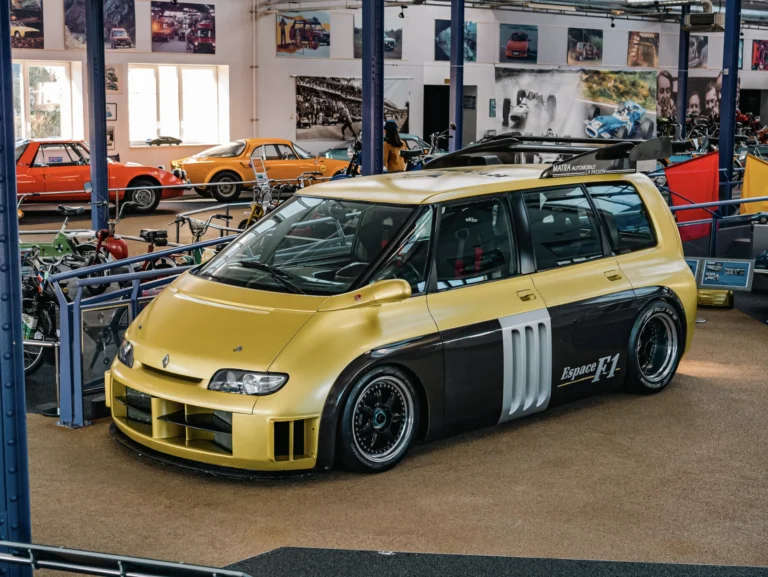
To the untrained eye, the Espace F1 loosely resembled a heavily modified version of the second-generation Espace. However, virtually nothing was carried over from the production assembly line. The bodywork was crafted almost entirely from carbon fiber to keep the center of gravity as low as possible and offset the inherent aerodynamic disadvantages of a minivan shape. The track was massively widened to accommodate the F1 suspension architecture, resulting in bulging, aggressive wheel arches that housed massive slick tires.
Aerodynamics played a crucial role in ensuring the vehicle didn’t take flight at high speeds. The roof featured a massive, prominent rear wing designed to generate substantial downforce, while the lower front fascia was dominated by deep air intakes to feed oxygen to the screaming V10 and cool the massive brakes. Despite these extreme modifications, the vehicle retained the iconic, angular glasshouse of the family hauler it was mimicking.
- hypercar
- minivan
- mid-engine
- rwd
- limited-edition
Beneath the skin lay a lightweight carbon fiber chassis specifically designed for this one-off application. This rigid tub was essential for managing the violent power delivery and maintaining structural integrity under extreme cornering loads. Standard MPVs prioritize cargo space and passenger comfort, but the Espace F1’s chassis prioritized ultimate rigidity, effectively transforming it into a Le Mans prototype wearing a sensible suit.
The Heart of a Champion
The defining feature of the Espace F1 is unequivocally its powertrain. Positioned mid-ship, directly between the two rear passenger seats, sits the glorious 3.5-liter Renault RS5 V10 engine. This naturally aspirated masterpiece was modified only slightly from its Formula 1 specification, primarily to ensure it could idle and operate without the constant umbilical cord of a pit crew. It generated a staggering 800 horsepower and 705 Nm of torque, numbers that were utterly unheard of in road-legal vehicles in 1995, let alone a minivan.
- Peak Output: 800 horsepower at a screaming 13,000 RPM.
- Transmission: A six-speed semi-automatic gearbox, operated via steering wheel-mounted controls.
- Soundtrack: Unfiltered, deafening F1 wail directly inside the cabin.
Because the engine was mounted directly in the passenger compartment without heavy sound deadening or a traditional firewall, the acoustic experience was violently loud. The heat generated by the massive V10 also meant that the four occupants were subjected to temperatures and decibel levels more akin to a race car cockpit than a family road trip. It was a visceral, sensory-overloading environment that demanded immense respect from anyone brave enough to strap into the carbon fiber bucket seats.
+ Pros
- Unmatched novelty and shock value
- Pure Formula 1 V10 soundtrack
- Astonishing track performance
– Cons
- Deafeningly loud cabin
- Zero everyday practicality
- Literally impossible to buy
Physics-Defying Performance
When unleashed on a circuit, the Espace F1 delivered performance figures that could shame the greatest supercars of the era, including the McLaren F1 and Ferrari F50. Weighing in at just 1,300 kilograms despite its large footprint, the power-to-weight ratio was phenomenal. It could catapult from a standstill to 100 km/h in a blistering 2.8 seconds, a metric that remains highly competitive against modern hypercars today.
Even more impressive was its acceleration to 200 km/h, which took just 6.9 seconds. Given a long enough straightaway, this modified people carrier could reach a top speed of 312 km/h. This straight-line dominance was perfectly complemented by massive carbon-ceramic brakes, allowing the Espace F1 to decelerate from 300 km/h to a dead stop in just 80 meters.
“When you sit in a family car and you hear that V10 engine starting right behind your head, it completely rewires your brain. It shouldn't exist, but you are so glad it does.”
The cornering capabilities were equally surreal. Thanks to the F1-derived suspension geometry and wide, sticky Michelin slick tires, the vehicle could generate immense lateral grip. Watching the tall, boxy silhouette navigate the corners of Circuit Paul Ricard with the agility of a single-seater was a sight that defied all conventional automotive logic.
The Ultimate Passenger Experience
Inside the Espace F1, the layout retained a nod to its utilitarian roots by offering seating for four. However, traditional plush captain’s chairs were replaced by heavily bolstered, rigid carbon fiber bucket seats equipped with multi-point racing harnesses. Passengers were subjected to the brutal, immediate shifts of the sequential gearbox and the raw, unfiltered violence of the V10 engine screaming just inches from their shoulders.
It was an exercise in extreme exposure. Without the insulation typical of road cars, every mechanical whine, suspension clunk, and exhaust pop was transmitted directly into the cabin. It required passengers to wear communication headsets just to speak to one another over the deafening mechanical symphony. It wasn’t built for a road trip; it was built to shock the senses.