
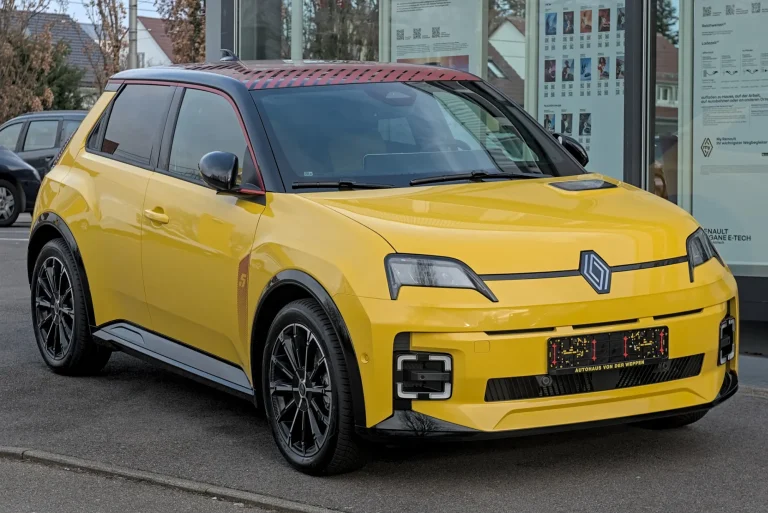
Bringing Back an Icon, Rewired for Electric
The original Renault 5 launched in 1972 as a cheerful, affordable hatchback that went on to become one of the best-selling cars in French history, later spawning the fire-breathing mid-engine R5 Turbo rally homologation special. Renault let the nameplate lapse for decades, but as the brand built out its electric lineup it returned to the 5 as the face of its EV ambitions rather than inventing a new name from scratch.
The new 5 E-Tech sits on Renault’s AmpR Small platform, an architecture it shares with the sportier Alpine A290, and was unveiled in February 2024 with deliveries beginning that same year. Rather than disguise its electric underpinnings, Renault leaned into the original car’s boxy proportions and round headlights, betting that nostalgia paired with genuinely modern technology would resonate more than a clean-sheet design.
That bet extended to where the car would be built. Renault chose to assemble the 5 E-Tech at its Douai plant in northern France, the same region where the original 5 had once rolled off the line, turning the launch into a symbol of the French auto industry’s push to keep EV production onshore rather than shifting it overseas.
Two Batteries, One Retro Shape
Buyers can choose between a 40 kWh pack good for roughly 300 km of WLTP range with a 95 hp motor, or the larger 52 kWh pack paired with a 150 hp motor that stretches range to around 400 km. The 52 kWh version, offered in the Techno and Iconic Five trims, represents the flagship of the lineup and the specification most road testers reached for when comparing the 5 against rivals like the Mini Cooper Electric.
- Power Output: 150 hp (110 kW)
- Torque: 245 Nm (181 lb-ft)
- 0-100 km/h: 8.0 seconds
- Battery: 52 kWh usable, 400 km WLTP range
A Motor Renault Actually Owns
Rather than buy in a conventional permanent-magnet motor, Renault developed an externally excited synchronous motor for the 5, a design that uses electromagnets instead of rare-earth magnets in the rotor. It is more complex to build but frees Renault from the supply chain risk tied to rare-earth mining, and the same motor family underpins the related Renault Megane and Scenic E-Tech models.
Renault also builds the motor domestically at its Cleon plant, with battery modules sourced from a nearby gigafactory partnership, keeping most of the drivetrain’s supply chain within a short distance of the Douai assembly line.
Fun Fact Higher trims of the 5 E-Tech offer an optional illuminated grille badge that can display a battery charge animation while plugged in, a detail styled after the charge-status lights on 1980s home electronics.
That combination of familiar styling and genuinely new engineering underneath is exactly what Renault leaned on when pitching the car to buyers skeptical of retro-themed EVs.
Retro Cues, Modern Underpinnings
Inside, the dashboard borrows the shape of the original 5’s simple, symmetrical binnacle but replaces analog dials with a digital instrument cluster and central touchscreen. Renault also used recycled and bio-sourced materials throughout the cabin, including denim-textured seat fabric intended as a nod to the original car’s famous 1980s Renault 5 TSE limited edition upholstery.
- Electric
- Hatchback
- Single-Motor
- FWD
The styling and materials strategy paid off almost immediately once the car reached European juries and press fleets.
An Award-Winning Return
In January 2025, the 5 E-Tech was named European Car of the Year, jointly honored alongside the mechanically related Alpine A290, giving Renault back-to-back wins after the Scenic E-Tech took the same award the year before. It made the 5 the eighth Renault-badged car to win the title, following past winners like the Renault 9 and the original Clio.
“It manages the rare trick of being genuinely nostalgic and genuinely modern at the same time, without either side feeling like a compromise.”
Living with the New 5
On the road, the 5 E-Tech prioritizes light, easy steering and a soft ride over outright sportiness, leaving the harder-edged driving experience to its Alpine A290 sibling. DC fast charging tops out around 100 kW on the 52 kWh version, enough to recover a meaningful amount of range in about 30 minutes at a suitable charger. That combination of quick top-ups and a genuinely usable everyday range has made the 5 E-Tech a realistic single-car choice for buyers who might have hesitated over earlier, shorter-range city EVs.
+ Pros
- Genuinely charming, period-accurate styling
- Rare-earth-free motor technology built in-house
- Competitive range and charging for its class
– Cons
- Rear seat and cargo space are tight for the segment
- Entry-level 40 kWh version trails rivals on range
- Not sold outside Europe at launch
None of those compromises have slowed demand; Renault’s Douai plant passed 100,000 units built within roughly fifteen months of launch, a pace few electric superminis have matched.
A revival that earns its name
The 5 E-Tech could have coasted on nostalgia alone and still sold reasonably well, but Renault instead built a genuinely competitive small EV underneath the retro sheet metal. It is proof that reviving a beloved nameplate doesn’t have to mean phoning in the engineering behind it.