
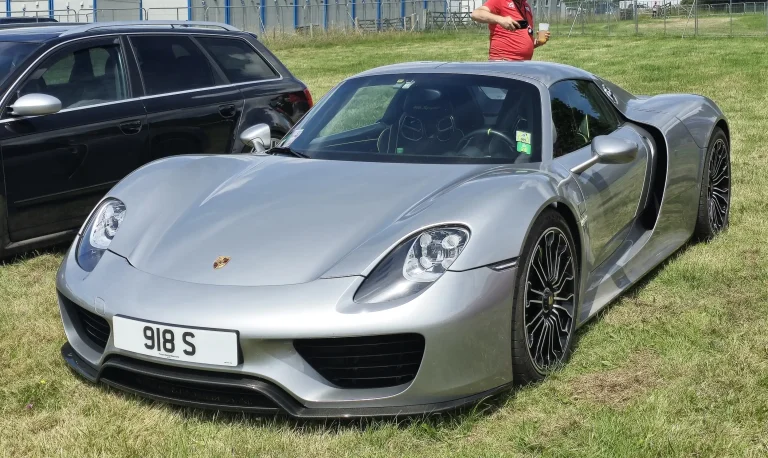
A hybrid halo car for a new era
By the early 2010s, Porsche needed a new flagship to replace the Carrera GT and answer the emerging threat from McLaren’s P1 and Ferrari’s LaFerrari. Rather than build another purely combustion-powered flagship, Porsche looked to its own Le Mans prototypes and 911 GT3 R Hybrid test mule for inspiration, betting that electrification could make its next halo car faster rather than slower.
The result, revealed in production form in 2013, was the 918 Spyder: a plug-in hybrid hypercar that borrowed its name and open-top silhouette from Porsche’s 1970s 908/918 racing heritage while previewing technology that would eventually trickle down into road-going 911s and Panameras.
- Hypercar
- Plug-in Hybrid
- AWD
- Mid-Engine
Porsche built exactly 918 examples between September 2013 and June 2015, all officially titled as 2015 model year cars regardless of when they left the Zuffenhausen manufaktory. The car sold out well before production ended, with roughly a third of the run finding homes in the United States.
Three hearts, one mission
At the center of the 918 sits a 4.6-liter naturally aspirated V8 derived from Porsche’s RS Spyder Le Mans Prototype racing engine, revving to a screaming 9,150 rpm redline. It’s supplemented by two electric motors: one integrated into the rear-mounted seven-speed PDK gearbox, and a second driving the front wheels independently, giving the 918 true all-wheel drive without a mechanical link between the axles.
“It doesn't just electrify the supercar – it redefines what one can be.”
Numbers that rewrote the rulebook
Combined, the V8 and electric motors produce 887 hp and 944 lb-ft (1,280 Nm) of torque, enough to launch the 918 from 0-60 mph in 2.5 seconds and on to a top speed of 214 mph. On its debut, it lapped the Nürburgring Nordschleife in 6 minutes 57 seconds, becoming the first road car ever to break the seven-minute barrier there.
- System Output: 887 hp combined
- Combined Torque: 944 lb-ft (1,280 Nm)
- 0-60 mph: 2.5 seconds
- Quarter Mile: 9.8 seconds
- Electric-Only Range: up to 12 miles
+ Pros
- Genuinely usable as a quiet, all-electric commuter
- Nordschleife-conquering performance with everyday AWD traction
- Racing-derived V8 soundtrack unlike anything else on sale
– Cons
- Complex hybrid hardware makes ownership costly to maintain
- Extremely limited production means sky-high resale prices
- Cabin storage and practicality are essentially nonexistent
Even by 2026 standards, the 918’s blend of a race-bred naturally aspirated V8 with dual electric motors feels like a technical high-water mark, one that arguably has never been fully repeated since Porsche, McLaren, and Ferrari each moved on to twin-turbo or fully electric successors.
A hypercar that changed the conversation
The 918 Spyder proved that hybridization could sharpen a supercar rather than dull it, delivering Le Mans-honed engineering, all-wheel-drive traction, and a seven-minute Nu00fcrburgring lap in a package you could still drive quietly to the shops on electrons alone.