
The Terrestrial Flying Saucer
How Peel Upgraded the World’s Smallest Car Into a Space-Age “Saloon Scooter”
Following the debut of the microscopic, single-seat P50, the Peel Engineering Company on the Isle of Man realized some drivers wanted a touch more luxury—specifically, the radical ability to transport a second passenger. In 1965, company founder Cyril Cannell unveiled the Peel Trident. It was marketed as the ultimate “shopping car” and a futuristic “transport of tomorrow—today.”
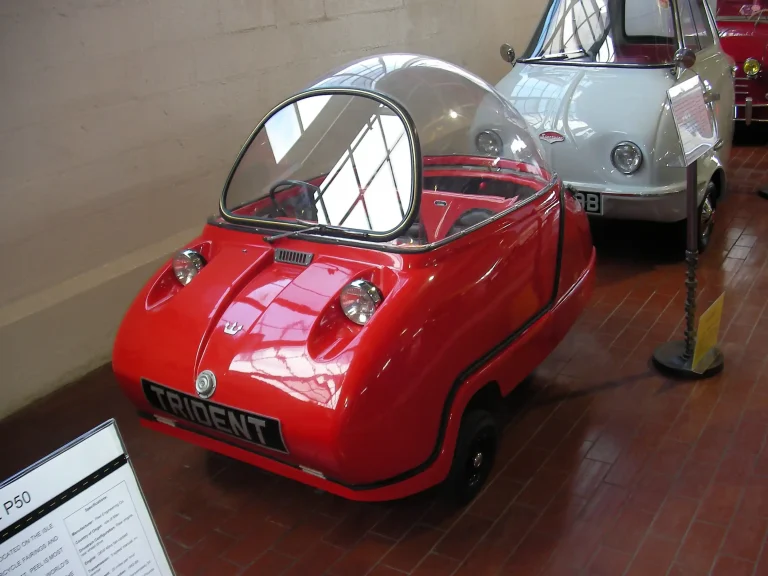
Instead of simply stretching the boxy P50, Peel completely redesigned the bodywork out of a single fiberglass monocoque shell, crowning it with a massive, clear acrylic dome. Looking less like a traditional automobile and more like an escaped prop from The Jetsons, the incredibly quirky microcar quickly earned its legendary nickname: The Terrestrial Flying Saucer.
The Flip-Top Solarium on Three Wheels
The defining feature of the Trident is its entry mechanism. The car has absolutely no doors. Instead, the entire upper front section of the bodywork—including the clear plastic bubble canopy—is hinged at the nose and tilts completely forward on a ratcheting hinge to let the occupants step inside.
While the bubble offered unparalleled panoramic visibility that made the tiny car feel far larger than it was, it introduced a brutal environmental side effect:
- On a clear, sunny day, the un-tinted acrylic dome acted as a rolling greenhouse, rapidly transforming the cabin into a literal oven.
- The sole source of ventilation was a tiny, primitive sliding plastic flap cut into the driver’s side of the bubble.
Two Seats and a Shared Weight Crisis
While the original P50 was strictly for one adult and a shopping bag, the Trident was designed as an occasional two-seater. The fiberglass bench seat inside stretched roughly 31 inches wide.
+------------------------------------+
|        [ 31-Inch Bench Seat ]       |
|  [ Driver Side ]   [ Passenger ]   |
|   Shoulder-to-     -Shoulder Cozy  |
+------------------------------------+
This layout meant that if two full-sized adults actually climbed inside, they sat completely shoulder-to-shoulder in an incredibly intimate embrace. Furthermore, because the entire empty car weighed a minuscule 330 pounds, loading two average adults into the cabin could easily double or triple the total weight of the vehicle, drastically altering its performance dynamics.
Same Tiny Heart, No Reverse Gear
To save manufacturing costs, Peel carried over the exact same mechanical package from the original P50. Nestled in the back was a tiny 49cc single-cylinder two-stroke engine paired with a three-speed manual transmission.
- The Power Output: The miniature engine generated a modest 4.2 horsepower, pushing the three-wheeled saucer to an advertised top speed of 38 mph.
- The Fuel Economy: It was staggeringly efficient, achieving a reported 100 miles per imperial gallon—validating Peel’s recycled, famous slogan: “Almost cheaper than walking.”
- The Parking Maneuver: Just like its older brother, the gearbox had no reverse gear. However, unlike the P50, which had a rear handle to let you lift it like a wheelbarrow, the wider Trident required drivers to get creative—often shuffling the lightweight car backward with their feet outside or executing a tight, three-wheel U-turn on a dime.
P50 vs. Trident: Choosing Your Micro-Moped
While they shared an engine and island heritage, the two stablemates targeted completely different styles of minimalist motoring:
| Attribute | Peel P50 | Peel Trident |
| Seating Capacity | 1 Adult (Strictly) | 2 Adults (Very Intimate) or 1 Adult + Shopping Basket |
| Cabin Entry | Single conventional side door | Forward-tilting bubble canopy (No doors) |
| Headlights | One single pod on the nose | Dual headlights integrated into the lower body |
| Total Production | ~50 original units | ~45 original units (Even rarer) |
The Verdict: A Holy Grail of Microcars
With only around 45 original units ever built between 1965 and 1966 before Peel Engineering closed its original doors, the Trident is one of the rarest, most sought-after microcars on the planet. Surviving examples are considered crown jewels of automotive design collections, regularly fetching six-figure sums at elite international auctions.
It stands as a beautiful artifact from the mid-sixties space-race obsession. It serves as permanent proof that when it comes to automotive charisma, a striking shape and a bold idea will always triumph over sheer horsepower and scale.