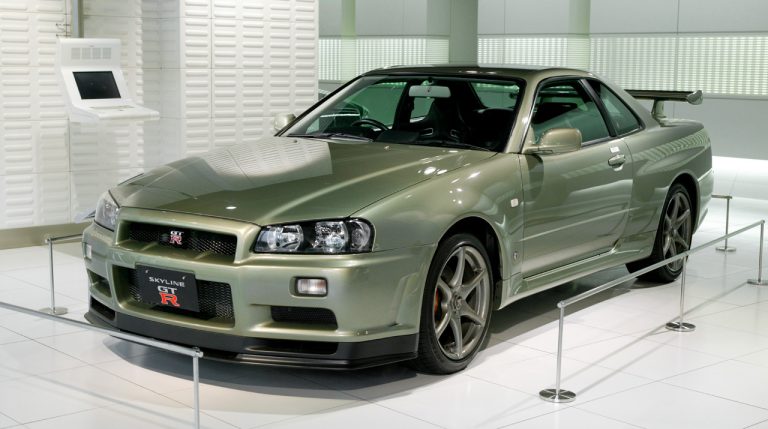
The Last of the Analog GT-Rs
Launched in January 1999, the R34 was the fifth and, in hindsight, final Skyline-badged GT-R before Nissan spun the nameplate off into its own standalone model with the R35 nearly a decade later. It replaced the R33, a car respected for its ability but criticized for feeling heavier and less urgent than the R32 that started the modern GT-R legend, and Nissan’s engineers set out to make the R34 tighter, stiffer, and more responsive than either car before it.
Underneath the shorter, more aggressive bodywork sat a stiffer version of the Skyline platform, developed with input from Nissan’s touring car and Le Mans programs. The R34 never had to prove itself only on Japanese roads; it also carried the GT-R name into international GT racing at a time when Nissan was chasing outright wins against Porsche and Toyota.
Fun Fact Every R34 GT-R left the factory with its speedometer capped at 180 km/h (112 mph), the result of a gentleman’s agreement among Japanese manufacturers. The car was fully capable of much more, a fact plenty of owners quickly discovered.
RB26DETT: An Engine Nissan Refused to Kill
At the heart of every R34 GT-R sat the RB26DETT, a 2.6-litre twin-turbocharged straight-six that had powered every GT-R since the R32. Rather than replace it, Nissan kept refining the same iron-block architecture, adding a new ceramic twin-turbo setup and revised ECU mapping for the R34 while officially keeping output at the same 280 PS every Japanese manufacturer agreed to cap performance cars at during the 1990s.
- Power Output: 280 PS (276 hp) at 6,800 rpm
- Torque: 392 Nm (289 lb-ft) at 4,400 rpm
- 0-100 km/h: 5.2 seconds
- Quarter Mile: 13.2 seconds
ATTESA E-TS Pro and the Multi-Function Display
Power reached all four wheels through Nissan’s ATTESA E-TS Pro system, which defaulted to rear-wheel drive and shifted torque forward only as needed, giving the R34 the traction of an all-wheel-drive car without feeling as inert as one. A Super-HICAS rear-steering system quietly adjusted the rear wheels at speed to sharpen turn-in and stability, technology drawn directly from Nissan’s Group A and Le Mans programs.
Inside, the R34 introduced a dashboard-mounted multi-function display developed with a boost gauge specialist, letting drivers monitor turbo boost, oil and water temperature, and lap times without aftermarket gauges, a feature that felt years ahead of anything else at its price point.
A Shorter, Stiffer Body for a Sharper Car
Compared with the R33, the R34’s wheelbase shrank by roughly 70 mm and the whole body was stiffened with additional bracing around the front strut towers and floorpan, changes aimed squarely at quicker direction changes on tight circuits like Tsukuba. The result was a car that felt noticeably more eager to turn in than its predecessor, even before any of the electronics got involved.
Nissan also widened the front and rear tracks slightly and revised the front bumper’s ducting to feed more air to the intercooler and front brakes, both areas that had limited sustained track use on earlier GT-Rs when they were pushed hard for long sessions.
- JDM
- Coupe
- AWD
- Twin-Turbocharged
All of that hardware came wrapped in a car that, on paper, looked no more powerful than the GT-Rs that came before it.
Underrated on Paper, Faster in Reality
The 280 PS figure quoted for every R34 was widely understood in the industry to be conservative, a way for manufacturers to publicly respect the agreement while quietly building faster cars underneath. Independent dyno tests of stock R34 GT-Rs regularly measured output closer to 320-330 PS at the wheels, and once the speed limiter and turbos were addressed, the same RB26DETT block proved capable of supporting well over 1,000 hp in modified form.
“Godzilla is back, and this time it eats Porsches for breakfast.”
Buying and Owning an R34 Today
Nissan built roughly 11,578 R34 GT-Rs across the standard, V-Spec, V-Spec II, and M-Spec grades between 1999 and 2002, a smaller run than either the R32 or R33 that came before it. Because the R34 was never officially sold new in the United States, most examples spent their early years in Japan before the 25-year import rule began opening them up to American buyers, driving demand and prices sharply upward.
+ Pros
- Massively tunable RB26DETT engine platform
- Sophisticated AWD and rear-steer chassis for its era
- Cult status backed by real racing pedigree
– Cons
- Import prices have climbed well past original MSRP
- Parts and service require JDM specialists outside Japan
- Many surviving cars have been heavily modified
None of that has slowed demand; if anything, scarcity and pop culture exposure have only pushed clean, unmodified R34s further out of reach for ordinary enthusiasts.
The GT-R that closed out the Skyline era
The R34 didn’t need a bigger number on the spec sheet to become the most desired Skyline GT-R ever built. It closed out two decades of Skyline-based GT-Rs with a chassis, engine, and reputation good enough to still command a premium over the fully modern R35 that followed it.