
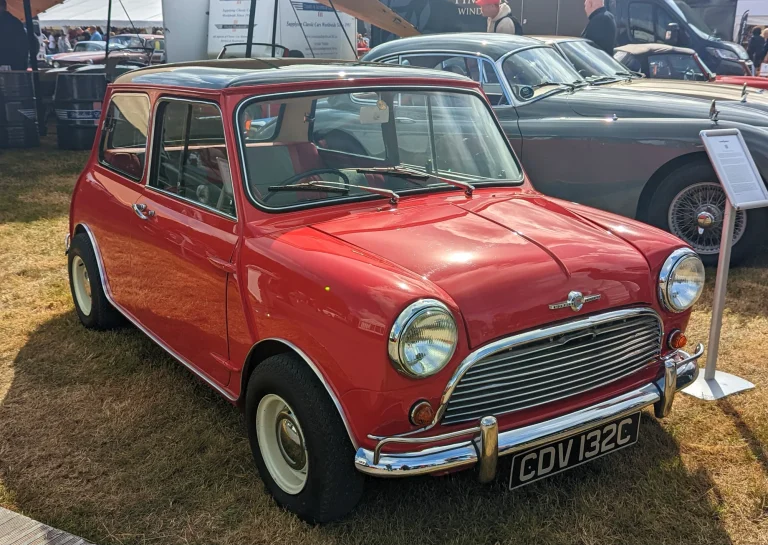
The beginning of the Mini performance legend
The Mini Cooper 997 was introduced in 1961 as the first production performance version of the classic Mini. Developed through the collaboration between Alec Issigonis and John Cooper, it proved that a small economy car could also deliver exciting driving dynamics and competition success.
Based on the original Mini platform, the Cooper 997 added a more powerful engine, improved brakes and subtle styling changes while keeping the lightweight character that made the standard Mini so revolutionary. It became the foundation for one of the most famous performance car stories in history.
- Classic
- Hatchback
- Front-wheel-drive
- Naturally-aspirated
Small size, clever engineering
The Cooper 997 used a modified version of the Mini’s transverse front-wheel-drive layout, which placed the engine and gearbox together to maximize interior space. Its compact dimensions and low weight created a unique driving experience that felt more like a lightweight sports car than a practical small vehicle.
Power came from a tuned 997 cc A-Series four-cylinder engine featuring twin carburetors and improved cylinder head design. While its output was modest by modern standards, the Mini’s low weight allowed it to deliver impressive acceleration and exceptional cornering ability.
- Power Output: 55 hp
- Torque: 70 Nm
- Engine: 997 cc Inline-4 A-Series
- Transmission: 4-speed manual
Fun Fact The Mini Cooper 997 was created after John Cooper recognized the racing potential of the original Mini and convinced BMC to build a higher-performance version.
Racing success and driving character
The Mini Cooper 997 quickly gained attention in motorsport because of its agility and ability to compete against much larger and more powerful cars. Its front-wheel-drive layout, compact wheelbase and low center of gravity made it extremely effective on twisty roads and racing circuits.
Behind the wheel, the Cooper 997 offered a direct and engaging experience. The small steering wheel, manual gearbox and lightweight construction created a sense of connection between driver and machine that became a defining characteristic of future Mini Cooper models.
“The Mini Cooper proved that performance was not about size, but about intelligent engineering and driving enjoyment.”
Legacy and collector importance
Production of the Cooper 997 lasted only a few years before it was replaced by the Cooper 998, making original examples highly sought after by collectors. Its rarity, motorsport connection and role as the first true Mini performance model give it a special place in automotive history.
The success of the 997 established the Cooper name as a symbol of lightweight performance. Later Mini Cooper generations continued this philosophy, but the original model remains one of the purest examples of the concept.
+ Pros
- Historic first-generation Cooper model
- Excellent lightweight handling
- Iconic racing heritage
- Unique classic driving experience
– Cons
- Limited power by modern standards
- Small cabin and minimal comfort features
- Rare examples can be expensive
A true automotive milestone
The Mini Cooper 997 was more than just a faster version of a small car. It introduced a new idea of affordable performance, proving that clever design and lightweight construction could overcome disadvantages in power.
The car that created the Cooper legend
The Mini Cooper 997 remains a landmark vehicle that combined practicality, racing spirit and pure driving enjoyment into one compact package.