The Grand Prix Racer with a License Plate
How the Mercedes-AMG ONE Brought True Formula 1 Supremacy to the Street
When manufacturers claim their latest supercar features Formula 1 technology, it usually means they borrowed some carbon fiber techniques or aerodynamic simulation software. When Mercedes-AMG announced their ultimate hypercar project, however, they meant something entirely different. They set out to take a genuine, championship-winning Grand Prix power unit and drop it directly into a road-legal car.
The engineering challenge was so immensely complex that it nearly broke the development team, pushing the release schedule back by years. To meet strict global emissions laws and idle smoothly at a stoplight without exploding, engineers had to rewrite the book on extreme thermal management and electronic hybridization, delivering an untouchable technical marvel that bridges the absolute peak of motorsport and road driving.
A True Championship-Bred Power Unit
At the very core of this carbon-fiber weapon sits a highly specialized, turbocharged split-compressor V6 engine. This power unit is directly derived from the ultra-dominant engines built by the brand’s high-performance powertrain division in England—the exact facility responsible for securing multiple consecutive world titles on the grid.
To survive on public roads, the mechanical layout was fundamentally adapted:
- The racing version idled at an unusable five thousand RPM; engineers successfully tuned the road variant to settle into a smooth low-RPM idle.
- The engine utilizes a pneumatic valve-spring system rather than traditional steel springs, allowing the mechanical assembly to rev safely to a screaming, stratospheric redline.
Because it operates on the absolute ragged edge of mechanical tolerance, the internal combustion engine is built for maximum intensity rather than permanent longevity, requiring a highly specialized complete factory powertrain rebuild after a specific block of driving mileage.
The Four-Motor Electric Synchronicity
To complement the screaming internal combustion engine, the hypercar utilizes an incredibly complex network of four independent electric motors, transforming the vehicle into a highly responsive, all-wheel-drive performance weapon.
The electrical architecture is distributed strategically across the frame:
- One specialized electric motor is integrated directly into the high-tech turbocharger shaft, instantly spinning up the compressor to eliminate any trace of turbo lag.
- A second motor is bolted directly onto the engine crankcase, transferring extra mechanical energy straight to the rear drivetrain.
- The remaining two electric motors are positioned on the front axle, providing full vectoring control over the front wheels.
This intricate hybrid layout delivers a completely seamless wave of acceleration, filling in lower power gaps instantly and clawing out of corners with mind-bending traction.
Active Ground Effects and DRS Control
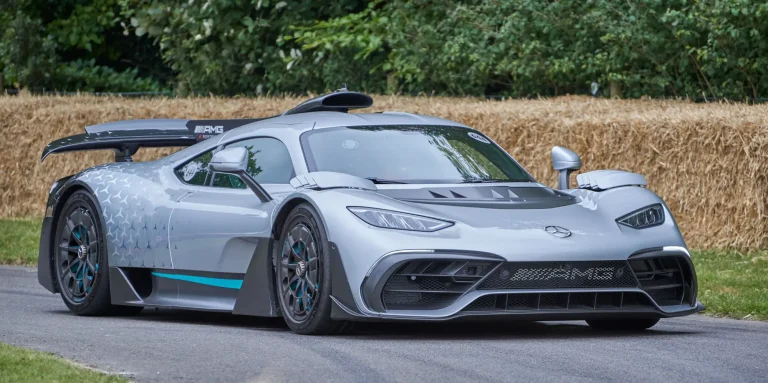
The bodywork is a pure exercise in functional aerodynamics, dominated by a massive aerodynamic shark fin that stabilizes the car under high-speed lateral loads and columns of active air vents carved directly into the front wheel arches.
The most dramatic motorsport feature is the integration of an authentic Drag Reduction System. At the touch of a button on the F1-style rectangular steering wheel, the active flaps on the front diffusers adjust and the two-piece rear wing drops its angle, dramatically slicing through air resistance to maximize straight-line speed.
Inside the sparse cabin, the driver and passenger sit clamped into deeply contoured bucket seats molded directly into the rigid carbon fiber monocoque tub, adjusting the pedal box and steering column directly to achieve a perfect racing posture.
The Verdict: An Untouchable Record Holder
With a strictly limited global production run, every single unit was spoken for long before the final assembly lines even began moving. Its engineering supremacy was fully vindicated when it shattered the production car lap record around the legendary Nürburgring Nordschleife, carving deep into the previous record time.
It stands as a completely unrepeatable moment in automotive history—a loud, proud, and impossibly complex triumph that fulfilled the wild dream of putting an authentic, modern Formula 1 powertrain directly onto public asphalt.