
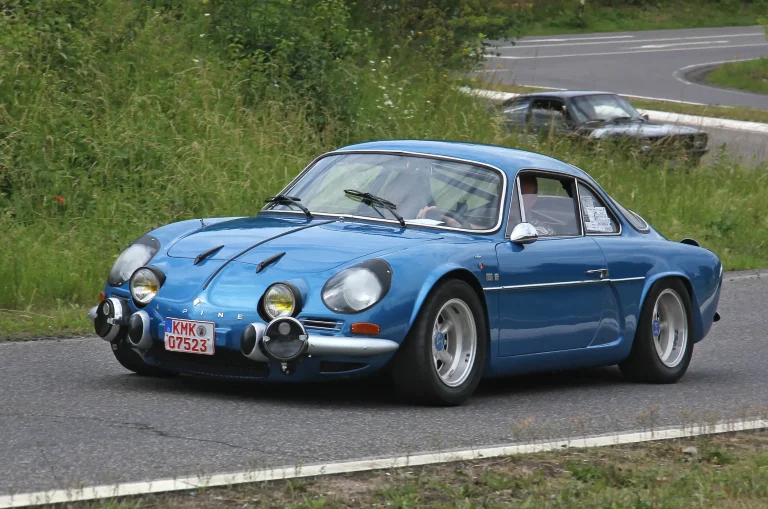
The Giant Killer of the Rally World
How the 1963 Alpine A110 Rewrote Motorsport History
During the golden era of classic rallying, the world was dominated by heavy, front-engined sports sedans. Then came a tiny, low-slung fiberglass creation from France that threw a massive wrench into the established order, permanently cementing itself as an international motorsport legend.
Born from the vision of founder Jean Rédélé, the car utilized a backbone chassis wrapped in an ultra-light fiberglass shell. It was incredibly small, unbelievably nimble, and built for one specific purpose: conquering the twisting, icy passes of Europe.
Rear-Engine Traction and Motorsport DNA
The defining characteristic of the platform was its rear-mounted engine layout, drawing components from proven Renault donor cars. Positioning the entire weight of the powerplant over the rear axle provided a massive competitive advantage: unrivaled traction on loose surfaces.
As drivers slid through snow, mud, and gravel, the weight distribution pinned the rear tires down, allowing the car to claw its way out of corners while heavier competitors struggled for grip.
The cabin was a cramped, loud, and direct workspace. There were no insulation blankets or luxury amenities; the driver sat inches from the floorboards, feeling every loose pebble and change in track topography directly through the steering rack.
Evolution to World Champion
As the decade progressed, the car was continuously upgraded with larger, twin-carbureted engines and five-speed manual gearboxes. The design evolved seamlessly, adding wider rear wheel arches to house meatier racing rubber without losing its iconic, teardrop profile.
The ultimate validation of this lightweight formula came when the car swept the international stage, securing historic victories at the demanding Monte Carlo Rally and ultimately claiming the inaugural World Rally Championship title.
The Verdict: A Timeless Masterpiece
The vintage legend is far more than a beautiful classic car; it is a monument to the philosophy of mechanical minimalism. It achieved immortality by proving that agility, lightness, and clever weight packaging could comfortably outrun raw horsepower.
Today, authentic early examples are highly prized collectors’ pieces, viewed as the definitive expression of French alpine racing heritage.